
PSMS Lessons Learned - June 2026 - Compromised Layers of Protection
June 2026
PSMS Lesson Learned
The ten elements of API RP 1173, in aggregate, serve as strong layers of protection design to preserve the safety operations of gas pipelines and in mitigating risk. However, there are times when these layers of protection are comprised. This lesson learned and summary illustrates how three elements were compromised.
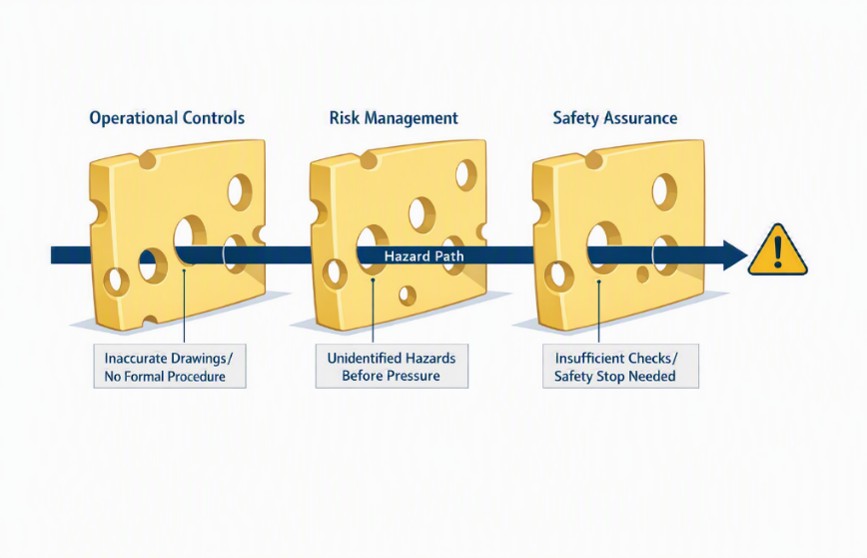
- Operational Controls – Existing drawings/prints were inaccurate, and there was no formal procedure for assessing/identifying the potential for unknown service locations. Also, the lesson learned about the daily job brief suggests hazard discussion and shared understanding were not fully effective before the work began.
- Risk Management – Hazards tied to unknown/unclear service connections were not fully identified or controlled before introducing pressure into the system.
- Safety Assurance – The need to review records more thoroughly and call a Safety Stop shows the existing checks were not strong enough to prevent the event.
Description of event:
The crew was performing transfer of services from a low-pressure main to a newly installed high-pressure main. Before tying over and gassing in the service, the crew performed an air pressure test when 40psi of air was introduced into house piping at a different location. The service to the new location was an underground branch service from the service they were currently working on.
Key Causal Factors and Root Causes:
- Primary Causal Factor: Improve Standard Policies and Administrative Controls (SPAC) - Drawings/Prints Needs Improvement (NI) - The drawings did not adequately address the presence of branch service conditions at both addresses.
- Causal Factor: Reinforce of SPAC- Enforcement NI: There is no formal procedure for identifying or locating the potential of branch service locations.
Key Corrective Actions:
- Thoroughly Review Job Package, main notes, construction notes, scanned records, and Service Pipe Database. Make a note of the absent records and inconsistencies.
- Walk the Job Down & visually look for indicators of potential branch services.
- During construction, when unknown facilities are encountered call a Safety Stop and re-assess the situation.
Key Lessons Learned:
- Daily Job Brief discussions are essential to ensure all potential hazards are identified and effective controls are in place.
- Best Practice: Service Transfers
- Before transferring a service, take the necessary precautions to be sure you're doing the job safely and to prevent damage to our assets. Some tools available for verification include Maps and Records including service cards.
- Use of Pipe Location Devices (If having difficulty marking out an adjacent service, contact Damage Prevention to request a problem locate.) If these means are inconclusive, performing test holes are recommended. When you cannot complete your job safely, always perform a Safety Stop and inform your supervisor.
Connecting the dots!
Several pipeline safety and process safety elements overlap in this lesson because both approaches to safety management systems are designed to prevent low-frequency, high-consequence events. Pipeline safety focuses on the asset and system integrity. Process safety focuses on the management systems and controls used to prevent a major event. Where they cross over is in how people use information, procedures, risk controls, and verification to keep the pipeline system safe.
- Pipeline Safety was compromised because the drawings and records did not accurately reflect the existing service configuration. The underground branch service created an unintended pathway, allowing pressure to be introduced into house piping at a different location. This exposed the pipeline system to an uncontrolled condition and demonstrated that asset information and field verification were not sufficient to protect the integrity of the system.
- Process Safety was compromised because the work process did not fully identify, evaluate, and control the hazard before pressure was introduced. The absence of a formal procedure for locating unknown service connections, combined with incomplete records, allowed a latent system hazard to remain undetected during the service transfer and pressure test.
- Personal Safety was compromised because employees, customers, and the public could have been exposed to an unexpected pressurization event with interior, non-jurisdictional house piping and end-use appliances. Without a complete understanding of connected services, the crew could not fully recognize the hazard during the job brief or apply the necessary controls before performing the pressure test.