
PSMS Lessons Learned - Compromised - July 2026
July 2026
PSMS Lesson Learned
The ten elements of API RP 1173, in aggregate, serve as strong layers of protection design to preserve the safety operations of gas pipelines and in mitigating risk. However, there are times when these layers of protection are comprised. This lesson learned and summary illustrates how four elements were possibly compromised.
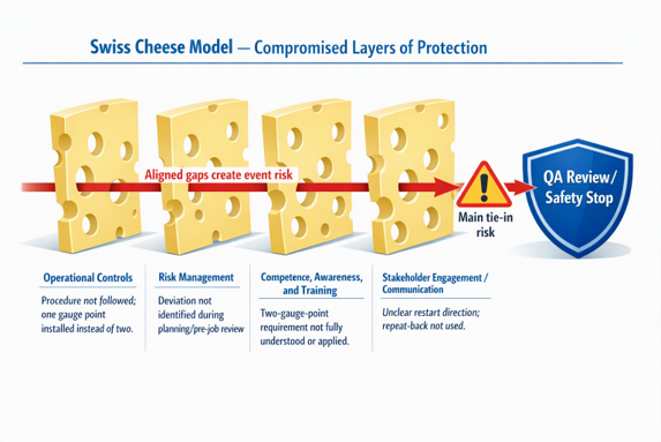
The primary compromised elements of API RP 1173 related to this event are Operational Controls, Risk Management, Competence, Awareness, and Training, and Stakeholder Engagement / Communication.
- Operational Controls — The required work procedure was not followed. Two active gauge points were required, but only one was installed. This indicates a breakdown in work procedure field execution.
- Risk Management — The hazard created by deviating from the gauge point requirement was not identified or controlled before work progressed. The QA review caught the issue, but the risk should have been recognized during planning or pre-job review.
- Competence, Awareness, and Training — The crew either did not fully understand or did not apply the two-gauge point requirement, suggesting a gap in work procedure awareness, task preparation, or reinforcement of expectations.
- Stakeholder Engagement / Communication — The contractor believed they were cleared to proceed, and “repeat back” was not used. This reflects a breakdown in clear communication between company representatives, supervision, and the contractor.
Description of event:
During a main tie-in to supply gas to a dead-end newly installed main, only one gauge point was installed on the existing main, then cut and installed on the new main. The work procedure requires two active gauge points for this activity, one on the existing main and one on the new main to be gassed in. During the on-site QA review, it was identified that only one gauge point was present, and a safety stop was initiated.
Key Causal Factors and Root Causes:
Primary Causal Factor: Work procedure Step 4, Detail A (sketch) was not utilized and followed correctly.
- Management System – SPAC Not Used – Enforcement NI
- Work Direction – Preparation – Walk-Thru NI
Causal Factor: Contracting crew was told their work was not going to be stopped/held up. Crew thought they were cleared to gas in main with the current gauge set up.
- Communications – No Comm. Or Not Timely – Late Communication
- Communications – Misunderstood Verbal Comm. – Repeat back not used
Key Corrective Actions:
- Contractor conducted two safety stand-downs to reinforce the importance and requirement to follow Procedures.
- The Gas Construction policy was forwarded to the contractor, with additional communication emphasizing the importance of correctly following all procedures.
- Tie-in work procedure requirements will be reviewed for future work to confirm continued compliance with Company Construction policies. This will be reinforced internally through Contractor Oversight and externally through Contractor Management for distribution to the workforce.
- Leads/Supervisors will reinforce expectations with crews during HUB calls and on-site to ensure two-gauge points are installed and all work procedure steps related to tie-in work are followed.
- Communication will be issued to crews and contractors reinforcing adherence to the work procedure and confirming applicable sketches are available, reviewed, and followed in the field.
- Construction standards will be reviewed to identify and address any potential gaps related to gauge point requirements.
- Highlight in HUB meetings and communications the importance of clear and concise communication between workers, managers, supervisors, etc., when restarting work after a safety stop.
- Reinforce the importance of the “Repeat Back.” This gives both the workers and Supervisors/managers clarity of what is going on and eliminates potential confusion.
Key Lessons Learned:
- Make sure all work procedures are reviewed prior for your work/task and are always followed correctly.
- If any potential deviation of the work procedure is required, contact Gas Control to debrief and explain the situation.
- Be as clear and concise as possible when communicating regarding work stoppages and restarts. If there is uncertainty, do not restart work until confusion/issue is cleared up.
- Utilize the "Repeat Back" process to mitigate confusion or unclarity around any verbal direction or communications. and inform your supervisor.
Takeaway: A single weakness may not lead to an event by itself, but when multiple protection layers have gaps at the same time, the path to risk can open. In this case, QA review served as the final barrier by identifying the missing gauge point and initiating a safety stop.
Connecting the dots!
Although several pipeline safety and process safety elements overlap in this lesson because both approaches to safety management systems are designed to prevent low-frequency, high-consequence events. Pipeline safety focuses on the asset and system integrity. Process safety focuses on the management systems and controls used to prevent a major event. Where they cross over is in how people use information, procedures, risk controls, and verification to keep the pipeline system safe.
Division of Compromises by Safety Focus
- Pipeline Safety
- Primary compromises: Operational Controls; Risk Management
- Why it fits: The missing second gauge point affected the integrity of the gas tie-in process and the ability to verify pipeline conditions before gassing in the new main.
- Process Safety
- Primary compromises: Risk Management; Operational Controls; Competence, Awareness, and Training; Stakeholder Engagement / Communication
- The event reflected weaknesses in the management system controls used to plan, execute, verify, and communicate.
- Personal Safety
- Primary compromises: Competence, Awareness, and Training; Stakeholder Engagement / Communication
- Why it fits: Unclear direction, lack of “repeat back,” and insufficient reinforcement of work procedure requirements increased the potential for workers to be placed in an unsafe condition during field execution.