
PSMS Lesson Learned - March 2026 - Layers of Protection
PSMS Lesson Learned
March 2026
Layers of Protection
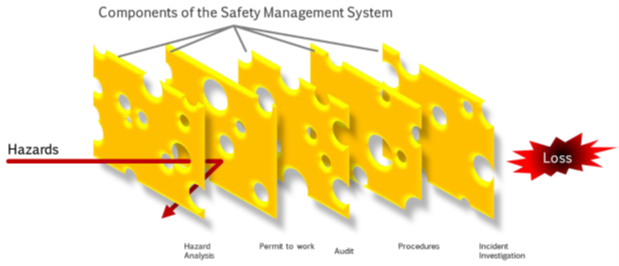
The elements of API 1173 Pipeline Safety Management System are designed as layers of protection to avoid unintended events. This event illustrates what occurred when several of the elements were compromised.
- Operational Controls – Leak response procedures were not followed, and an improper tool was used
- Competence & Training – Required verification methods and tool limitations were not properly applied in the field
- Management of Change (Field-Level) – Deviations from standard practices occurred without a safety stop
- Safety Assurance / Oversight – Infrequent audits and evaluations failed to identify procedural noncompliance.
- Leadership & Safety Culture – Enforcement of standards and policy reinforcement were insufficient.
Description of Event:
A company employee was responading to an odor complaint located at a school. During the leak investigation, the employee inadvertently pierced a plastic gas service while drilling bar holes with a rotary gun to locate the source of a Type 3 leak. Drilling was based solely on service card measurements, and other location verification techniques were not utilized. This resulted in an unplanned service interruption affecting two customers
Key Causal Factors/Root Causes:
Causal Factor:
Failure to follow the Leak Response and Repair policy, specifically:
- Not gathering necessary location documentation
- Using a rotary gun within the tolerance zone instead of a slap hammer.
Root Cause(s):
- Management System – Standards, Policies, or Admin Controls (SPAC) Not Used – Enforcement Needs Improvement (NI)
- Procedures – Followed Incorrectly – >1 Action/Step
- Management System – Oversight/Employee Relations – Infrequent Audits and Evaluations
Key Corrective Actions:
- Random Field Audits: For the next six months, supervisors will conduct random field audits and hold two Effective Safety Discussions (ESDs) per month, focusing on leak investigations and ensuring both measurement data and tone are consistently applied.
- Incident and Equipment Review: Use Hub calls to share incident learnings and review the proper tool usage within the tolerance zone (rotary gun vs. slap hammer). Adjust rotary gun bit length to prevent penetration below the hard/top surface.
- Policy Reinforcement and Documentation: Review the Leak response and Repair policy with staff. During leak investigations, document the use of both measurements and tone in job briefings.
Key Lessons Learned:
- Adherence to Standards: Employees must follow company Standards and Policies. When uncertain, initiate a safety stop and review applicable Gas Work Methods before proceeding.
- Mechanized Equipment Safety: Always verify that mechanized tools are configured to prevent penetration below the hard or top surface to avoid striking underground facilities
API RP 1173 functions as multiple, overlapping layers of protection against unintended events. Operational Controls prevent errors at the point of work, while Competence and Training ensure employees understand and correctly apply those controls. Management of Change captures risk when conditions or practices deviate from the norm. Safety Assurance detects weaknesses through audits and oversight before incidents occur. Leadership and Safety Culture reinforce expectations and accountability across all layers. Incidents occur when several layers fail at once; effective PSMS implementation restores defense‑in‑depth.