
EIA Winter Outlook Highlights Natural Gas Affordability for Northeast Households
As Northeast households prepare for another heating season, new federal projections offer encouraging news for families that rely on natural gas to heat their homes.
The U.S. Energy Information Administration's (EIA) 2026–2027 Winter Fuels Outlook projects that Northeast households heating with natural gas will see a significant reduction in winter energy expenditures, even as heating oil prices are expected to rise sharply. The findings underscore the continued affordability of natural gas and its important role in meeting the region's energy needs.
Natural Gas Delivers Affordability for the Northeast
According to EIA, Northeast households that primarily heat with natural gas are projected to spend an average of $879 on natural gas between November and March, a 14% decrease from last winter.
By comparison, EIA forecasts average winter electricity expenditures of $1,637 for Northeast households primarily heating with electricity and $1,687 in propane expenditures for those heating with propane. Nationally, households primarily heating with oil are expected to spend an average of $2,115.
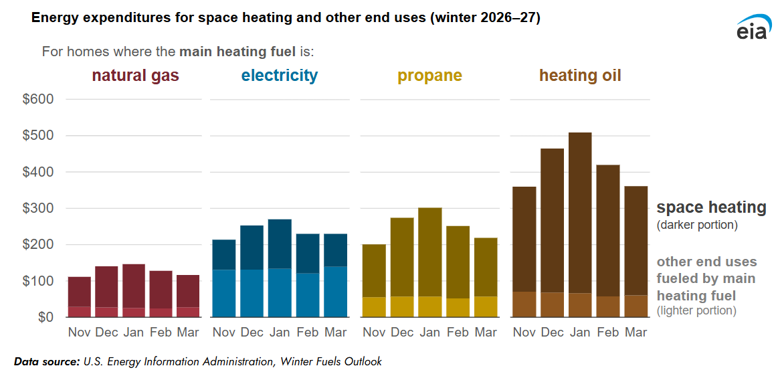
The chart illustrates how monthly energy expenditures vary throughout the heating season, including the portion attributable to space heating. While individual household expenditures depend on weather, home characteristics, and energy consumption, EIA's projections highlight the continued affordability of natural gas for Northeast families.
Importantly, lower natural gas household expenditures are not solely the result of an anticipated milder winter. EIA also projects that residential natural gas prices in the Northeast will decline approximately 5% this winter, while national residential heating oil prices are expected to increase approximately 34%.
The differing price trends reflect the distinct markets that supply these fuels. Heating oil prices are closely tied to global petroleum markets, while domestic natural gas production, infrastructure, and utility purchasing practices play important roles in supplying natural gas to American consumers.
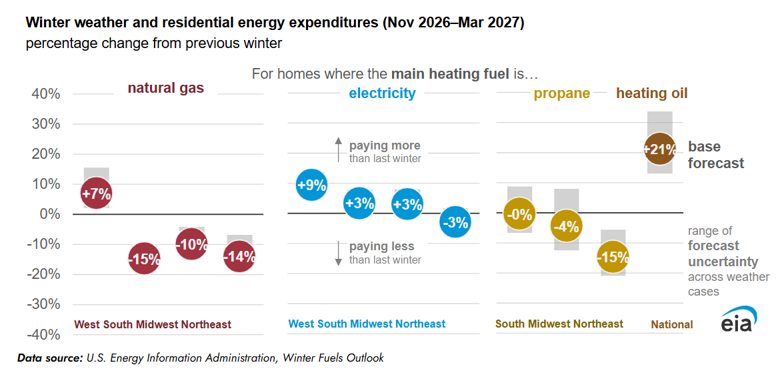
As the graphic illustrates, EIA projects a 14% reduction in Northeast household natural gas expenditures compared with last winter, while nationally, household heating oil expenditures are expected to increase 21%. These projections reflect both anticipated fuel prices and heating demand, providing a broader picture of the financial impact on households.
Together, these findings reinforce the value of affordable, abundant American natural gas as part of the Northeast's diverse energy portfolio.
NOTE: During periods of peak demand, pipeline constraints into New England can force the region to turn to LNG. According to EIA, "on peak demand days, imported LNG can contribute up to 35% of New England's natural gas supply." as a result of this reliance on imported LNG, New England's gas prices can become more susceptible to global market impacts."
Millions of Northeast Households Continue to Rely on Natural Gas
Natural gas remains the most widely used primary home heating fuel in the Northeast.
EIA estimates that approximately 12.4 million Northeast households rely on natural gas for their primary heating needs, substantially more than those primarily using electricity or heating oil.
That number continues to grow. Contrary to suggestions that natural gas is going away in the Northeast, EIA estimates approximately 28,000 additional Northeast households primarily heating with natural gas in 2026 compared with 2025.
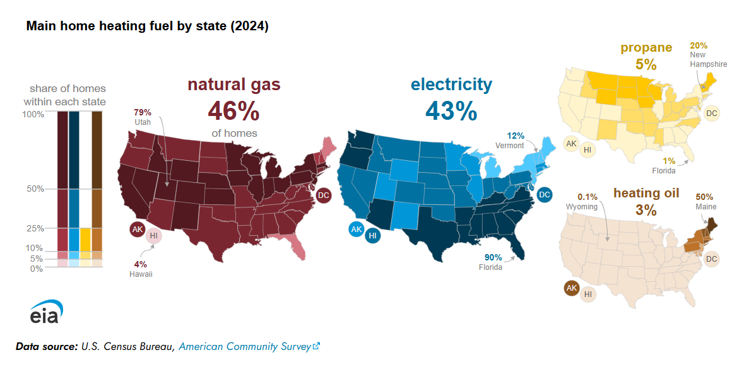
These figures underscore the essential role of natural gas infrastructure in meeting the region's energy needs and the importance of continued investment in safe, reliable energy delivery systems.
Affordability Must Remain a Priority
Energy affordability remains a major concern for families and businesses throughout the Northeast. EIA's latest outlook provides an important perspective as policymakers, regulators, and energy stakeholders consider the region's energy future.
While weather and energy market conditions will ultimately influence actual winter expenditures, the forecast demonstrates the significant value natural gas continues to provide to Northeast consumers.
As the region works toward a more affordable, reliable, and sustainable energy future, preserving access to natural gas, supporting critical energy infrastructure, and maintaining consumer choice will remain important components of a balanced energy strategy.
Source: U.S. Energy Information Administration, Winter Fuels Outlook, October 2026.